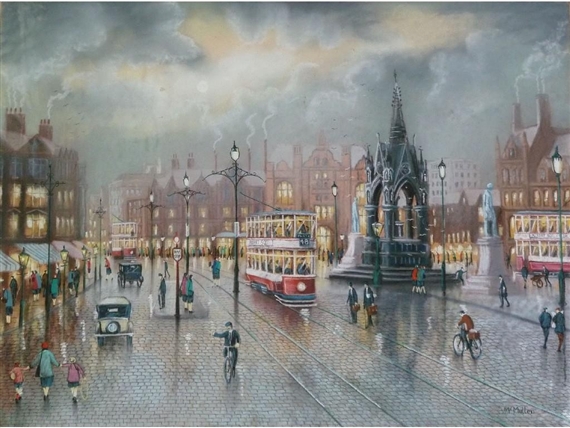
The period following the Second World War was a time of intense transformation in Britain. The period represents a profound shift in consciousness in the nation that was concerned with not only the loss of its empire – a properly global historical event of discernible consequences – but also building a new welfare state. In this crucible of change, literature was instrumental for not only representing the tumultuous times, but also for shaping the connections between Britain’s imperial past and the post-imperial future. The writers constructed a new aesthetic, which functioned as a vital cultural infrastructure – a foundational system that helped society reimagine its identity.
This course delineates literature’s role as an infrastructure for defining the plausibility of a new social order and the scope of political change in post-War Britain. We will discover how literature brought forward narratives to process the end of the British Empire, the language to demarcate social justice, and the imaginative space to conceive of a Britain that encountered the following key issues: Austerity and the Welfare State; Decolonization; Class and Education; as well as American Influence. We will discuss why ‘telling stories’ not only fulfilled the need of cultural production, but also built an ‘information infrastructure’ to illustrate intuitive and explicit systems involving social relations and experiences, which were both articulated and contested. Cultural struggle of post-War Britain came to the forefront, but its complexities were also recorded, particularly from the standpoint of subordinated groups. Literature, thus, became an infrastructure for delineating difficult social choices and recuperating dissent. We will discover where the importance of literary infrastructure lies: not in the magical evocation of fictitious worlds, but as a discourse of authority in the contention regarding the question of extending the British sense of possibilities of human lives.
Following on from this framework, this course will trace how contemporary British writings have continued to explore themes of social change and the complexities of identity in a rapidly evolving society, moving beyond dominant paradigms to highlight diversity and transnational influences in a postmodern context. Underlining some significant shifts in the cultural landscape, for example, Brexit, the course will engage with persisting issues related to race, gender, and class, and how these are reflected in contemporary literary texts. Thus, the aim is to determine the ‘enduring relevance’ of literature representing all the possible meanings of ‘the battle of Britain’ in today’s context, which incorporate Britain’s connection with Europe, America, and the rest of the world.
Texts: Graham MacPhee, Postwar British Literature and Postcolonial Studies (Edinburgh: Edinburgh University Press, 2011); Rachael Gilmour and Bill Schwarz eds., End of Empire and the English Novel since 1945 (Manchester: Manchester University Press, 2011); Matthew Whittle, Post-War British Literature and the ‘End of Empire’ (London: Palgrave Macmillan, 2017); Stuart Ward ed., British Culture and the End of Empire (Manchester: Manchester University Press, 2001); Daniel Lea, Twenty-First-Century Fiction: Contemporary British Voices (Manchester: Manchester University Press, 2017); Ali Smith, Autumn (London: Penguin Books Ltd., 2016); Kazuo Ishiguro, The Remains of the Day (London: Everyman’s Library, 2012); Zadie Smith, Swing Time (London: Penguin Books Ltd., 2017); Caryl Phillips, Color Me English: Reflections on Migration and Belonging (New York: The New Press, 2011); David Stephen Mitchell, Cloud Atlas: A Novel (London: Penguin Random House, 2004); Ben Okri, Astonishing the Gods (London: Phoenix, 1996); Andrea Levy, Small Island, (London: Headline Review Books, 2004); and Bernardine Evaristo, Manifesto: On Never Giving Up (London: Penguin Books Ltd., 2022).